
The Work Ahead
by
Notes from Below (@NotesFrom_Below)
November 17, 2026
Featured in The Work Ahead (#28)
Our editorial for Issue #28

inquiry
The Work Ahead
by
Notes from Below
/
Nov. 17, 2026
in
The Work Ahead
(#28)
Our editorial for Issue #28
The work ahead of us can often feel daunting. We might know where we want to go, but taking the first step is far from easy. This editorial comes from trying to think this through collectively, both with the current issue and themes that have come up in past issues. This issue features a range of pieces from workers on the front lines of our social worlds. Of course, we think these struggles can teach us a lot about the work ahead.
Last year, union membership increased by 192,000 to 6.6 million, or 22% to 22.4%. While this might not sound like much, especially since union membership has fallen from a peak of 13.2 million in 1979, it still represents over 192,000 people joining a union (and even more, given membership churn). It is difficult to know what led to those people joining, whether they see it as insurance, or if they are becoming union militants. What is interesting is that 76,000 workers, a significant part of this growth, work in the private sector. This 3% rise could signal something more interesting.
Union membership is a signal, but not always a helpful one, for understanding workers’ self-activity. A change in union membership levels is a sign of ‘formal organization’, but as George Rawick argued, it is ‘not the heart of the question of the organization of the working class.’1 Instead, we want figures on how many hours were lost to production because of strikes or details of workers’ victories in wrenching back control from capital. If we have a long road ahead of us, we need to both keep an eye on that horizon while also looking for moments of opportunity along the way. The pieces in this issue from hospitality and care show workers on the front lines of what building workplace power today can look like. However, we are still a long way from rebuilding institutions of working class power, whether unions or other forms.
This editorial considers these opportunities, including the openings from the Employment Rights Act, while balancing them against the need to prepare for what is coming. This issue features a piece on the struggle against ICE in Minnesota. Earlier this year, some of the NfB collective went to Labor Notes in Chicago. Among the many lessons we took from the visit, we were inspired by the stories of what had happened in Minnesota. We want to think about the lessons we can learn to help us understand what is happening in Britain today. The comparisons between the US and Britain are not only about looking across the Atlantic at a potential future. The same dynamics are already unfolding in Britain.
An ICE of our own
Since July 2024, some 17,000 immigration-related arrests have been made in Britain - a 122% increase on the previous two years - while deportations have risen by 50%, reaching 2,357. In the first months of 2026 alone, there have been 7,270 immigration raids, up 31% on the same period last year, resulting in 4,756 arrests, a 20% increase. These operations fall disproportionately on the workplaces and communities in which migrant workers are concentrated, particularly distribution, food delivery, construction, agriculture, beauty, retail and hospitality. They take place in workplaces far from metropolitan centres, in warehouses, factories, and farms in peri-urban hinterlands. But they also take place in big city centres: between January and June of this year, 1,814 raids in London have resulted in 1,256 arrests.
Immigration raids and arrests are set to intensify with the implementation of new legislation from the 1st of October. Under new immigration law, parent employers found employing undocumented workers could face fines of up to £60,000 per worker or five years’ imprisonment. Previously, large companies could avoid liability for their workers’ citizenship status through subcontracting, reaping the benefits of a low-cost, highly vulnerable workforce without assuming the associated legal risks. Now parent companies take full responsibility for right-to-work checks. Consequently, we should expect a massive operation of collusion between employers and immigration enforcement in an attempt to crack down on illegalised workers. Indeed, leading up to these changes, large-scale immigration enforcement operations have taken place in delivery depots and warehouses across the country. Between 2022-24 and 2024-26, immigration enforcement visits to warehousing, distribution, and delivery services increased by 446%, raising arrests from 458 to 1,946.
The labour movement and the left in Britain have failed to respond to this massive assault on workers, and are ill-prepared for its significant worsening under a Reform government. The large bureaucratic unions, who have spent years nursing sweetheart deals with food and parcel delivery companies while failing to organise one of the economy’s most powerful and exploited workforces, have much to answer for here. But broader parts of the organised workers movement have also been slow to register these offensives. Meanwhile, recent street blockades in Dover, Portsmouth and elsewhere show how developed far-right border vigilantism has become in parts of the country. In many ways, the factors priming the country for a far-right takeover, going much deeper than parliamentary control, have been developing for some time. Less visible, but no less present within this development, are the elements of class struggle and communist reproduction which will no doubt play a role in whatever comes next.
Learning from Minnesota
The extremes of Trump’s border-enforcement regime have given spectacular form to a new repertoire of authoritarian tactics. These are fast becoming the hallmarks of twenty-first-century far-right state repression: children abducted from their families and put into cages, civilians shot dead in broad daylight, masked agents mobbing workplaces with impunity, and private citizens encouraged to participate in the policing of migration. It is tempting to see these scenes as unique to the aberration of a far-right ascendancy to global political power, or to imagine that such tactics belong to some dystopian future towards which Britain might only gradually drift if a Reform government comes to power. A future Reform government would no doubt seek to emulate Trump’s shock-and-awe politics to satisfy its electoral base. But the escalation of state repression against migrant workers is not something waiting down the line after the rightful guardians of parliamentary power have been unseated. In a less spectacular, but no less consequential, form, it is already here.
Conversations with organisers involved in the anti-ICE general strike in Minnesota have made clear just how important this period is for building muscles for a popular resistance movement. On January 23rd 2026, hundreds of thousands of workers in Minnesota downed tools for a single-day general strike. It was the peak of collective action within a much longer 74-day resistance to Operation Metro Surge, the Trump government’s militarised occupation of the twin cities of Minneapolis and Saint Paul in the far north of the United States. This itself was part of a much longer phase of more gradual organising stretching back at least to the George Floyd uprising. Vitally, the strike was successful. The mass deportation campaign had to be brought to a premature close, the leadership of ICE were fired, and the fascists withdrew to lick their wounds.
Following the murder by ICE of Renee Good, organisers in the Twin Cities began to grapple with the need for escalation. The idea of a general strike, which had been floated abstractly before this point, began to be tested in union meetings. Stewards in unions like the communications workers were brought together and asked if they thought a general strike was an appropriate response. The answer was not at all guaranteed: many of the stewards in these unions represented members who voted for Trump, or had voted for him themselves. But prior struggles had prepared their enthusiasm for a call to action, testing their willingness to take risks on smaller-scale bread-and-butter issues.
The call for action was issued with ten days’ notice. On the day itself, 15,000 unionised workers from 90 local unions sparked off an illegal general strike of 350,000. A demonstration of 70,000 to 100,000 took over the city in temperatures of minus 23 degrees Celsius. In key unions like the communications workers, 82% of members stayed away from work. The strike’s impact varied widely by workplace. In some places, managers shut down production in coalition with, or under pressure from, their workforces. In others, the closure was much more emphatically enforced from below.
The day after the strike, ICU Nurse Alex Pretti was murdered. That killing was just the first indication of the state’s repressive reaction. But rather than break the movement, the violence sparked a reaction: ICE and the local police were forced into retreat, and the site of the murder was claimed and held as a memorial. The combination of the strike and the refusal to back down in the face of deadly violence was a clear indication that the federal government and its repressive forces were destined to lose that phase of the struggle in Minneapolis.
Deep and Wide
The strike was just one moment in a much larger movement. The infrastructure the Minnesotan working class built to resist ICE and Metro Surge was remarkably deep and complex. It had as its bedrock ordinary community relations, local and public services and workplace organisational structures.
Schools acted as nodes of working class self-defence, with their designated managers relegated to the role of backseat drivers. Educators took over and ran their own workplaces, organising everything from anti-ICE hometime patrols to food drives, rent fundraisers, and buddy systems that allowed racialised students and their families to go underground for the duration. Regional pod structures grouped these increasingly self-managed schools in each neighbourhood to coordinate mutual aid.
Neighbourhoods ran traffic blockades and early-warning systems by mass-distributing 3D-printed whistles and organising a network of 60,000 people via the encrypted messaging app Signal. Carpenters took it upon themselves to fix kicked-in doors, mechanics towed abandoned vehicles from the site of kidnappings to safe locations for storage until their owners were released from detention. Healthcare was provided for free, outside the framework of the state and border regime (not just acute medicine but also longer-term demands like pre- and antenatal care).
Union branches ran rideshare systems to get their members to and from the workplace and keep racialised workers away from high-risk locations like bus stops. The immigration defence committees they formed at the start of the second Trump term swung into action and coordinated bargaining with bosses to reinforce the fight against ICE: hotel workers demanded that their bosses kick ICE agents out of their rooms. They began using their workplace power to defend the wider class.
These developments were not spontaneous. Minneapolis was one of the epicentres of the George Floyd uprising in 2020. Lessons learned from that confrontation with the repressive apparatus carried over to the next struggle. Barring major technical or social recompositions that break down working class self-organisation, cycles of struggle build on each other. Workers gain experience, learn lessons, and practice skills that will be called on later.
The subjective developments that emerged from the strike are difficult to pin down, but discussions with organisers and shop stewards point to the extreme heaviness of facing a paramilitary occupation. To give a sense of the scale of the siege, at the peak of Operation Metro Surge, 3,000 ICE agents were drafted into the Twin Cities where the combined total of sworn police officers is only around 1,000. Yet alongside this dread was a near-universal sense that nobody was coming to the rescue. Participants understood, even if only temporarily, that they were the primary agents in a class struggle to defend themselves and their neighbours.
The objective results have been more direct. SEIU Twin Cities took their first official strike action for 26 years in the wake of the campaign. The communication workers have launched five new organising campaigns at workplaces that were completely inactive before Metro Surge, including a residential nursing home. The educators are relaunching a rank-and-file caucus within their union and preparing for a new fight against redundancies. Overall, the labour movement has grown dramatically. Meanwhile, repressive efforts by the state have stepped up. 15 workers and trade unionists have been indicted by the FBI and accused of conspiracy, as part of the wider fascist repression of working class self-organisation.
London, Manchester, Sheffield, and Bristol - none of these are Minneapolis. It would be comical to suggest we just mirror their experience. But the next time we are told that joining an electoral formation is the only way to stop the far right, or that anybody not willing to vote for the Labour Party isn’t serious about confronting fascism, we have a clear and easily communicable answer: look at Minneapolis.
The billionaire elites at the head of the ruling class are increasingly calling on the fascists as political allies. A far-right international is at work to destabilise those governments that offer even the most tepid resistance to their advance. We have no illusions about the seriousness of the moment. But we know where resistance and transformative social structures come from. The cycle of struggles we engage in now, with its movements that flare and dissipate, and the ever-escalating risk-taking and experimentation involved, can open the way for a sharp left turn. Where then in our present can we see the forces which might slow, or altogether divert, the trajectory ahead?
Frontlines in Britain
As the inquiries in this issue demonstrate, workers are building networks, capacity, and resources through their daily experiences of workplace organisation to enable larger-scale working-class struggle. In Minnesota, we saw the centrality of those working on the frontline of education, social care, public transport, and hospitality to the mass resistance against ICE, and the organisation of a general strike. As in the US, in Britain it is the teachers, carers, bus drivers, baristas, and bar staff who have the knowledge to organise in local neighbourhoods – knowledge of who lives where, how, and with what kinds of vulnerabilities and strengths. When those workers fight for their own working conditions, they also fight for our shared social infrastructure. The work ahead is not only to build capacity in our unions, but to build capacity as a class.
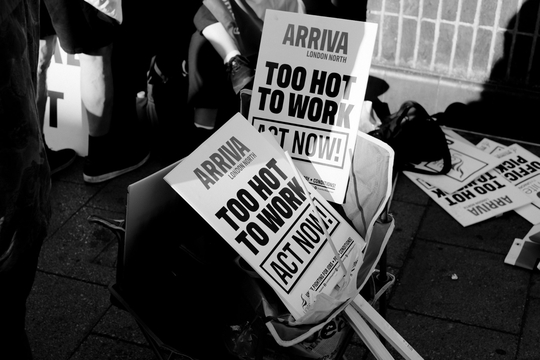
Notably, in many examples of collective organisation in this issue, the demands and campaigns workers have pursued have gone beyond the immediate issues of pay and contract conditions (often the focus of much trade union activity), to contest the very orchestration, meaning, and purpose of their work. In seeking greater control over the function and organisation of their labour, these workers point to the broader political horizons of working-class struggle. We might think about how the group of social workers and social care assessors, discussed in the “Social Care Inquiry Group” piece, gathered together with the initial aim of identifying solutions to the broken system of adult social care. Or how the bus drivers of North London interviewed in this issue have contested their unbearable working conditions brought on by successive heatwaves, and in doing so have placed themselves at the forefront of workplace struggles over the effects, costs, and burdens of the climate crisis.
The ability and desire to reimagine the content, purpose, and orchestration of work is not always explicitly stated; instead, it can emerge through everyday practices. One example is the ‘Care Home Inquiry’ in this issue, which shows how care workers’ intricate knowledge of residents’ specific needs and their complex understanding of the logistics of the work are vital to running shifts smoothly. These informal groups of workers possess the ability to wield this knowledge, and therefore their power, in significant ways - both in the immediate interest of care workers themselves, as well as in reimagining care work altogether. While the care sector remains largely unorganised, and employers’ ability to remove workers’ access to their Health and Care Worker visa remains an ever-present threat, new forms of self-organisation are emerging. The migrant care workers involved in the Pan African Workers’ Association are one example of this, and show that the vital work of building the capacity to challenge the racist and increasingly hostile conditions of work which migrant and racialised workers face is happening.
This is also true in other largely unorganised sectors, as demonstrated by the historic strike at the Village Hotel detailed in this issue. Here, immediate wage demands (and significant gains) were central to workers’ collective organisation. This struggle in turn galvanised further forms of collective action, which increasingly centred on workers’ ability to exercise, and gain, autonomy. In other contexts, attempts by hospitality workers to creatively exercise autonomy in their workplace have been juxtaposed with the inadequate approaches trade unions often adopt in the sector. As the “Ode to a Ceiling” piece in this issue shows, when union officialdom prioritises recognition agreements with employers, it often comes at the expense of building workers’ power from below. These examples, alongside the Kimpton Hotel workers’ inquiry featured in this issue, reveal workers’ determination not to dismiss front-line service jobs as degrading work to be escaped, but as sites where workers’ power can and should be built. Even if, as the account of organising a Kimpton illustrates, this process is often fraught with challenges.
Wringing more from less
A recurring feature of recent contributions to issues of Notes from Below has been workers describing the continuing degradation of their work. Catalysts for struggle are the basic miserliness of our workplaces, and the experience of being asked to do a good job in bad faith. Not only are terms and conditions deteriorating, but the supposed social uses of our work are undermined. This is apparent across this issue too. It’s clearest in Achille’s account of outsourced cleaning work. He describes how cutting constant capital in cleaning (the dirty old mops squeezed of all their value) forces workers into a position where “you have to work more, the work is harder.” Making the work harder often naturally reduces output quality. Achille notes that managers counter this drop in quality with increased workplace surveillance and discipline.
This description might seem surprisingly relatable to workers across many sectors. How often do we feel our jobs are becoming harder, that the quality of our work suffers as we struggle to do more with less, and that the ways of measuring our performance multiply while our autonomy diminishes? A Care Home Inquiry, by outlining the mechanics of the care work labour process, shows how exploiting workers diminishes the quality of care they can provide. It also raises how this degradation of work opens up new possibilities for workers’ struggles to draw in consumers and service users. The Social Care Inquiry Group also make this connection in their reflections, noting how their wins are “‘for us’ as well as for ‘service users’, as we do not enjoy working so hard to see so few positive outcomes”.
We find the same trajectory in hospitality. In the contribution from the Kimpton Hotel strikers, they describe not having enough mugs and cutlery for full service, with workers having to rush to clean and polish to meet shift demands. Working more and working harder. In the background, the cultures of observation and surveillance are there, with workers using the codeword “Netball Club” to discuss their union. In another contribution from a hotel strike in Glasgow, we see how management victimises striking workers and deploys excessive spending on scab labour rather than meet their demands. We also hear how the state is mobilised in an attempt to discipline workers, deploying a threatening police presence at picket lines.
Here the stakes of the degrading technical composition of work become clearer. This tendency toward diminished output quality, driven by underinvestment in constant capital and the squeezing of more value from workers, is necessarily enforced by an authoritarian turn. This can span from the petty surveillance of bullying managers to the murderous violence of ICE agents in Minnesota that we hear about in Paul Kirk-Davidoff’s reflection. As Margaret Kimani’s writing shows, the violence of the border is already mobilised in Britain to discipline workers into accepting the broken and inadequate conditions of production.
In this view, the struggles that we wage in the workplace, against this tendency of degrading labour, must be an essential feature of the work ahead. Being able to identify this tendency points to where struggles might emerge. The question then is whether we have the tools and levels of organisation to win them. The stakes of these wins are not just improved terms and conditions, but whether we continue on this path of doing more with less alongside the violence it brings. To transform the labour process in workers’ interests, using the expert knowledge we all have of our own conditions, means using all our weapons. In Britain, we might have just accidentally been given a few new ones…
New opportunities
Employment law is rarely the most exciting part of class composition. It sets the general terms of acceptable exploitation, regulating some work activities and attempting to prohibit some activities. In a previous special issue, we published inquiries from workers in the legal sector that explored some of these issues further. In the current conjuncture, changes in employment law deserve some attention. More specifically, laws in Britain covering trade unions and strikes are changing. This matters because it sets the terrain for collective organising. If workers want to organise a strike, the law provides a protected route. This does not rule out other forms of strikes or collective action, but it makes some tactics easier or harder to use. For example, unions are unlikely to support wildcat action because of the legal threats involved. Therefore, workers have to organise the strike themselves, with a potentially higher threshold for action.
The so-called “biggest change in employment rights in a generation” is now underway. Although delayed and watered down, the Employment Rights Act has now come into force. The last time we had improvements on this scale was in the 1990s. Many young workers organising today hadn’t even been born then. First came the Trade Union and Labour Relations (Consolidation) Act in 1992, then the Employment Relations Act in 1999, which introduced further changes, including the new statutory union recognition procedure. In preparation, the TUC launched the Organising Academy to train a new generation of paid organisers. The TUC saw a new opportunity: a process to force employers to negotiate with unions. They recognised the potential for growing unions and were prepared to invest to do so. The new Employment Rights Act introduced a range of changes that could also be opportunities. These include improved protections for strike action, simplified balloting and union-recognition processes, access to non-union workplaces, doubling strike mandates to twelve months, and allowing electronic and in-person balloting.
Yet, unlike the last time, there has been very little preparation for this. Many unions have not prepared alternative balloting methods. Some unions, like the RMT, are clearly taking advantage of the new recognition agreement processes - if the reports on new union workplaces are anything to go by. When the Financial Times leads with a headline about ‘the union shock coming for UK employers’,2 we should be taking advantage of those fears. The FT details how the National Care Group, among many care companies, is now having to prepare for the ‘shock.’ An employment lawyer is quoted as warning that now ‘every employer in the country could have unions knocking on their door.’ This has inspired some unions to knock on doors, but perhaps not to have the kinds of conversations the FT is scared of. The changes are triggering a renaissance of partnership deals. For example, Prospect is now in talks with Meta.3 This is despite the United Tech and Allied Workers (UTAW) branch of CWU actively trying to organise workers in the sector. It should come as no surprise that large unions like GMB, who previously signed a sweetheart deal with both Uber and Deliveroo, despite workers organising with IWGB, see this as their own kind of opportunity. Unions with a history of partnership, like USDAW with its notorious Tesco deal, are rubbing their hands with glee.
This opportunity also highlights the tensions and deep-seated problems within the labour movement. Access to workplaces can bring more workers into the labour movement as active participants, but it could also mean land grabs by unions with no incentive to organise. Other opportunities exist, but they also risk unions losing control. For example, the decision to remove 50% minimum ballot thresholds has been delayed, with some union staff reportedly saying they would like to keep it in place. Similarly, if the focus is on bargaining and maintaining the union, rolling out an easier way for workers to go on strike may not have the same appeal. Indeed, in some unions this could empower branches and rank-and-file members to take action. These changes could represent new opportunities for rank-and-file workers. On their own, these legal changes won’t make any difference. However, new union campaigns and strikes that take advantage of these opportunities could show a way forward for building worker power today. These are only opportunities if we act on them.
Our Work Ahead
We face unprecedented challenges and opportunities in the current conjuncture. The questions that come out of this issue are not about ‘formal organisation’ and what parties can or should do. Instead, they are about how we understand the question of working class organisation. We need a sober analysis of our challenges, matched with passion about what we could do together. Our work ahead is to take advantage of the new openings we have discussed in the editorial, building our abilities and capacities as workers to act in new and creative ways. Beyond the workplace, we have seen more people willing to take risks with serious consequences. For example, shutting down arms factories and targeting complicity in the genocide in Palestine. Over 3,000 people have been arrested for protesting the proscription of Action Palestine. Climate protestors have faced increasing repression, yet continue to organise disruptive actions. In many communities, when immigration raids attempt to seize people off the streets, protests are quickly organised in response. This is the spirit we need to rebuild working class power.
Many of us deliver a service at work that we know has been hollowed out. We are burned out through lack of resources and time, and we see the problems on the front line. If we are to fix the world around us, it needs to start with those fighting on the front lines, not leaders above us. Hospitality workers are providing a powerful example of what is possible right now: kickstarting union campaigns, experimenting with old and new tactics, and showing what rebuilding the labour movement could actually look like. This organising is how we go beyond partnership, but it need not be limited to unions’ aims. If we look to Minnesota, the clearest lesson is that we need to start organising already to meet the challenges ahead. This might be an old problem, but we can face it together in many new ways.
Featured in The Work Ahead (#28)
author
Notes from Below (@NotesFrom_Below)
Subscribe to Notes from Below
Subscribe now to Notes from Below, and get our print issues sent to your front door three times a year. For every subscriber, we’re also able to print a load of free copies to hand out in workplaces, neighbourhoods, prisons and picket lines. Can you subscribe now and support us in spreading Marxist ideas in the workplace?
Read next
Too Hot to Drive, Just Right To Fight
by
An anonymous bus driver
/
July 15, 2026
