An Ode to the Ceiling
by
Mais Robinson
November 17, 2026
Featured in The Work Ahead (#28)
On working, organising and resistance in a social club.
inquiry
An Ode to the Ceiling
by
Mais Robinson
/
Nov. 17, 2026
in
The Work Ahead
(#28)
On working, organising and resistance in a social club.
It was K who did it one shift He had placed a nub of blu-tac on the end of a pen to secure it to the ceiling whenever he didn’t need it. K was very tall. As such, it was a practical (if not slightly more fun) place for safe keeping his writing utensils. It sparked the beginning of a collective creative refusal, and an exercising of autonomy in a space we felt was ours. As other staff began to contribute items to stick to the ceiling, it grew as an evolving public gallery of the workplace and our labour within it.
We worked at a committee-run members’ bar in North London. The venue was founded in 1919 by trade unionists who purchased a local cottage to form a workingmen’s club, with membership open to card-carrying trade union members, for local social, cultural and political activity, but began to admit non-union members from 1959. It was and continues to be managed and run by elected committees, volunteers in charge of the finances, hiring, entertainment, management and chosen at an AGM every year.
For 7 months, from summer 2023, the period of the ceiling’s colourful existence and ultimate demise directly coincided with the staff’s attempt to organise our workplace, placing in parallel mainstream union organising and creative worker resistance (as well as the employer’s response to both). The ceiling became another site of our burgeoning class struggle.
It grew organically, quickly forming a rite of passage for new staff members to contribute to. One worker described it as a ‘community art project’, sacred to those who were involved. The bounds of what counted as ceiling-worthy were broad and expansive: a beermat, a duck caller, empty crisp packets, receipts, children’s toys, drawings, bottle caps, an unused tampon, rosary beads. Things found and made, things trash and treasure, all welcome on the ceiling.
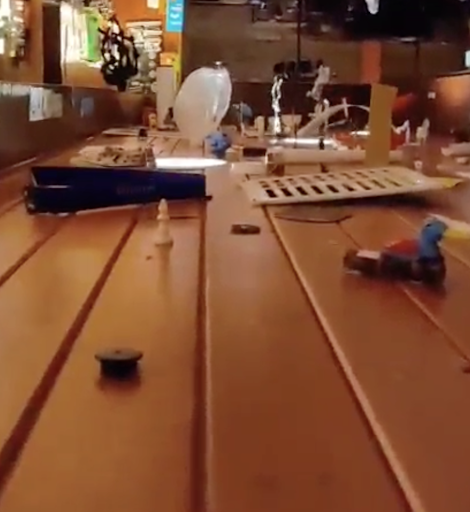
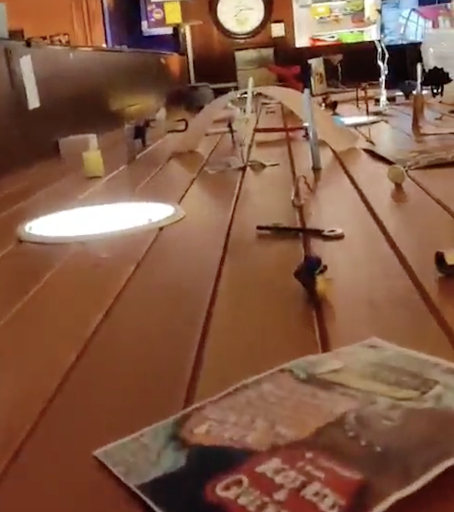
[Two pictures of the ceiling in Autumn 2023, taken upside down from opposite sides]
Each item gained collective resonance in their new configuration, a grotty surrealist assemblage of found objects. In being stuck overhead, the items subverted their everyday use and meaning, thereby subverting the workplace itself. The used crisp packet transcended its familiar cycle of transaction, consumption and disposal by gaining a pride of place in the growing installation. Not every item was important in of themselves (though some did hold sentimental value) but, rather, was made important in this new context.
The ceiling was an archive of bar work. And it soon became disgusting and hazardous, because working in a bar can be disgusting and hazardous: climbing into the dishwasher to scrub brown sludge off its roof; flies swarming in summer; customers throwing up in the bathroom; a fire starting in the smoking area bin; death threats from a man dressed as a priest (who was not, in fact, a priest). So the ceiling mirrored this reality.
Hospitality workplaces are often split into zones, which dictate the worker’s role, behaviour and level of autonomy. This spacial division is an important part of the securing of hierarchy within the workplace: workers can eat, sit and be on their phones, but only out of the view of customers on short, scheduled breaks; when they are behind the bar, they are surveilled, by security cameras and management, but also by the customer, who requires their constant engagement in affective labour to uphold the ‘vibe’ that is really paying being paid for. Behind the bar, you are a representative, but you also hold power, you reserve a right to deny service for any non-discriminatory reason, you control the pace of service. If someone is waving cash at you to get your attention, the unspoken rule is that you collectively ignore them. Solidarity lives behind the bar and in the back. Out on the floor is the customers’ domain, where workers collecting glasses duck and dive, snaking between friendship groups and lovers to grab empties, cleaning up tables after customers, watching silently as unsupervised children joyfully leave ungodly amounts of mess in their play’s wake.
In many ways, the ceiling was a project of taking ownership of our workplace. The art stayed within the staff areas, covering the expanse of space where customers could not and would not go. But it was also contained to the staff area most seen by the public, the site of our most observed, regulated labour. When the committee eventually did react to it, its visibility to customers was a primary pinch point for them: don’t take ownership of the space in which you work and certainly don’t let customers know you’re doing that.
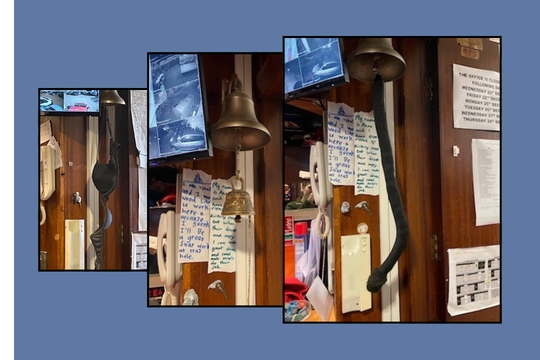
It grew beyond the ceiling too.Soon notes from the children of regulars were posted on the walls, and the last orders bell was adorned with a bra that had been found under a table in the upstairs bar.
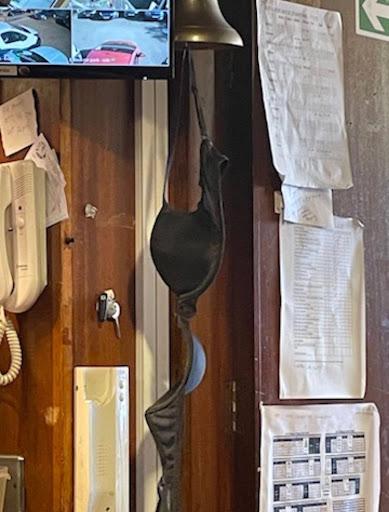
Then when that was deemed inappropriate, we changed it for another, smaller bell.
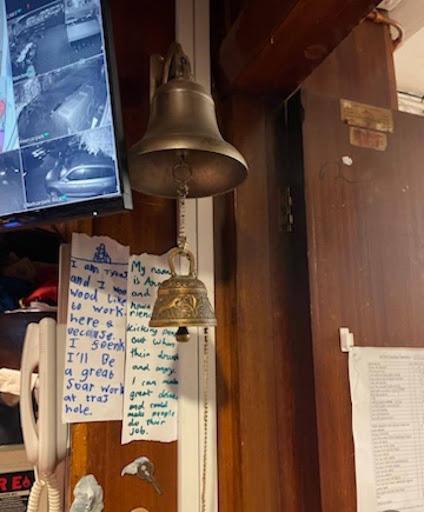
And when that was mysteriously removed, we replaced it with a costume cat tail.
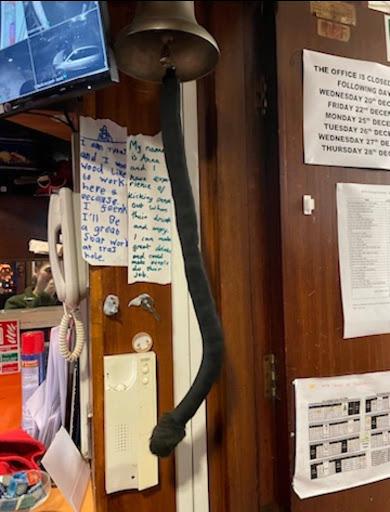
Which eventually was also mysteriously removed.
We weren’t breaking any rules, because the rules didn’t exist yet, our expression existed outside employer regulation, who couldn’t possibly pre-empt our desire to collectively procreate this gravity-defying gallery. So, at first, we received no complaints. The bar managers added as much as anyone else, customers were curiously bemused, and the committee stayed silent.
The barworkers began seriously talking about starting a union in July 2023, and by August a group of us had voted in favour of making it official. The catalyst was an increased atmosphere of toxicity and distrust between the majority of long-term staff and the committee. The most active committee members (and the ones with most authority) tended to be those who were regulars at the venue, socialising in the same space they managed, placed in a position of power at a venue which is also integral to their social lives. Boundaries were set but often overstepped, resulting in an acute example of the informalisation of working relationships that is seen across hospitality. Most of the committee members were well-liked by staff, and a mutual respect existed between us rooted in a shared love of the venue. However, the structure of the committee also allowed for unprofessionalism to go unchecked, with a lack of robust accountability systems, leading to egregious treatment of staff by two or three committee members who equated responsibility for ownership and drunk heavily. Our first collective grievance focussed on this behaviour, requesting that ‘membership committee members lose all managerial powers as soon as they have had a drink on the premises.’
In other initial discussions we also brought forth a number of demands which had cropped up in staff venting over and over: to get off zero-hour contracts, to get a bigger ice machine, to receive monetary tips (instead of alcohol), to fix the dumbwaiter so we didn’t have to lug heavy trays of glasses up the stairs, narrowly avoiding bleary-eyed revellers multiple times a night. We didn’t ask for a pay-rise initially, even though wages had recently fallen below London living wage (as the threshold rose), because our most acute payroll issue was that workers didn’t have security in shifts. We received our weekly rota a couple of days in advance, with shifts allocated sparingly.Sometimes workers would find that they only had one shift when they usually had three, unable to plan their finances or find extra employment to fill the income gap at the last minute.
In organising, most of us were treading new ground, guided by the hands of Unite officials who were not au fait with the needs of organising a small, local, non-profit venue. The Union focussed on gaining a recognition agreement with our employer rather than building long-term worker power and real organising skills. It was a long, frustrating process that dampened our sharp anger and placated management, contradicting our well-founded antagonism with the committee. By its conclusion, the repressed transience of the workplace burst and the union saw a flurry of active members leaving the venue, having held out to see the process through. Despite initially securing a small pay rise, to this day staff are on zero-hour contracts, and no formal negotiations have taken place since.
The committee were ‘more than happy’ to engage in the union recognition process, in fact many of them were members of unions themselves, they assured us. They positively, if not passively, engaged with the Union. But through their growing oppressive response to our other forms of resistance, management’s true position was made visible, in a way that it wasn’t through the recognition process. Letting us unionise didn’t equate to workers having more stability or power.
Boundaries for self-expression began to be set and moments of staff autonomy, tips and art, were increasingly removed or heavily regulated. A quiet war began between the committee and the workers, they removed our tip jar (telling us it looked like we weren’t paid enough, which we weren’t), so we skewered maltesers onto the ceiling with toothpicks. In November, a committee member documented the more unpleasant items on the ceiling, demanding we remove them. She wasn’t wrong. We had a fly problem that had continued in a big way through winter, and the dirty food packaging, old covid test, and candy sculptures secured above were likely part of its cause. We begrudgingly agreed to take these select items down, thinking this would be the limit to the sanitisation. One worker wrote in marker, on the edge of the ceiling ‘remember the committee is always watching’. So, the committee took down the ceiling in its entirety, and we put a new tip jar on the bar. All the while, formal negotiations were going swimmingly, the recognition agreement was going to plan.
And when the ceiling was finally cleared in January, with no warning, no explanation, all items thrown into the bin without mercy, it was crystal clear what management’s position was. It told us, as one worker put it: ‘you’re here to work, not to have fun’.
The barworker was thus presented to the public through a curated image: not well-paid but paid enough to not need a tip jar; smiling, sunny and, crucially, authentic dispositions that belied the control and surveillance we were under; A clean, professional bar where mice, trash and flies were only storied in tales of yore; well-respected workers, listened to by a benevolent management who readily supported the union.
The ceiling wasn’t planned or strategised - sometimes it was added to with thought, sometimes on instinct - but on reflection, it revealed a tendency for us workers to find a creative form of collective refusal. We were expressing and rejecting our exploitation and communicating the inadequacies of the Union’s approach, and by doing so reclaimed some small level of autonomy and power behind the bar, if nowhere else. These were things that we otherwise didn’t (perhaps we couldn’t) articulate, but they were there clear as day, dangling from above our heads until they were ripped from view.
Featured in The Work Ahead (#28)
author
Mais Robinson
Subscribe to Notes from Below
Subscribe now to Notes from Below, and get our print issues sent to your front door three times a year. For every subscriber, we’re also able to print a load of free copies to hand out in workplaces, neighbourhoods, prisons and picket lines. Can you subscribe now and support us in spreading Marxist ideas in the workplace?
Read next

The Afters: Building a Hospitality Workers’ Movement in Glasgow
by
Nick Troy,
Odhran Gallagher
/
Aug. 21, 2024