Nice Ideas vs. Hard Truths: A Social Work Inquiry Group
by
Harry
November 17, 2026
Featured in The Work Ahead (#28)
On inquiry and organising within a local government social work team.
inquiry
Nice Ideas vs. Hard Truths: A Social Work Inquiry Group
by
Harry
/
Nov. 17, 2026
in
The Work Ahead
(#28)
On inquiry and organising within a local government social work team.
Introduction
I decided to train as a social worker three years ago because I was looking for a job where I could help people who were struggling. I joined a fast-track training scheme called ‘Think Ahead’, which aimed to address a need for more specialist social workers in mental health teams across the UK.1 At university days, I remember speaking to fellow trainees from all different backgrounds. Some were fresh from undergraduate courses, while others were looking for a career change at a later life-stage. Some had been drawn to working in mental health from their own experiences, or those of their family. Others had little ‘lived experience’ of their own. But what clearly unified this diverse group was a feeling of shared values; that we had been drawn to this profession because we believed it was somewhere we could have a tangible, positive influence on individuals and communities.
This passion was further stoked by our educators, who encouraged us to step forward into our placement teams as vocal advocates for equality, justice and freedom. Our lectures and seminars highlighted how the oppressions of ableism, racism, sexism and more manifested within the existing delivery of public sector services. Fighting for change in this regard was the job of social work according to our education – not to carry out the functions of local governments and health services, but to successfully challenge the social conditions which produce misery for people with mental health conditions. This was the possibility presented to us and which further captured my imagination about the transformative work I would be able to do.
Fast-forward three years and that imagination has been all-but extinguished, bulldozed by the realities of a threadbare system which consistently fails vulnerable people. In fact, while we were still training, the predominantly negative reflections shared among trainees during university days made clear to me that I was not alone in finding that the dream sold to us had basically turned out to be an impossibility. I have found that the disconnect between our fairly progressive education and the depressing reality can be summed up as a battle between ideas about improving social conditions and the material conditions underpinning public services in a country ravaged by decades of austerity. This battle ceases to even be a battle when nice ideas are so frequently beaten down by the harsh truths of an underfunded, privatised care system.
What follows here is partly an outline of these contradictions which are inherent to the care system. More importantly, it is an account of how a group of social workers and social care assessors in the boroughs of Richmond and Wandsworth shared their realisation that social work is set-up to fail. Rather than accepting this or drifting out of the profession, as many do, we decided to see what we could do through workplace organising and campaigning to recover the idea which had brought us to the profession in the first place – to fight for a version of social work wherein we actually have the autonomy, resources and networks required to improve people’s lives. My hope is that this retelling of our organising efforts might inspire others to similarly join together and fight in their workplaces to challenge the depressing conditions of adult social care, so we can start building and organising the wider movement of (social) workers power required to redefine and remake ‘care’ in favour of those we support and for us as workers.
Social Work within Adult Social Care
Social workers, and social care officers, play a fundamental role in the delivery of adult social care within local authorities in England.2 The regulatory body Social Work England (SWE), states ‘A social worker’s role is to listen to and support people, empowering them to improve their lives. They also protect them from harm when necessary, this is called “safeguarding”’.3 The role of a social worker necessarily expands beyond this definition as workers look to support people to manage complex and unpredictable life circumstances and process difficult feelings. We must also work flexibly with personal networks, including: healthcare professionals; paid carers; unpaid carers such as family and friends; and a range of workers and volunteers who similarly support the individual. Social workers carry out ‘needs assessments’ – ‘needs’ being so-defined by the Care Act (2014) – with a view to securing further support and funding from the local authority to organise a ‘care package’, which is usually delivered by an external, private care company, to be supplemented by voluntary sector services.
The “empowering” SWE expects social workers to do is supposedly a function of effective, collaborative support planning between social worker, service user and their wider network.4 No matter how expansive this work becomes, through casework we only act-upon an individual’s circumstances to try and make their life bearable within their society, never affecting meaningful change to the societal causes of their difficulty. While care packages are partially funded by local authorities, service users themselves are often financially assessed and expected to pay ‘client contributions’ based primarily on their income and savings, which is often an unpleasant surprise to the individual. Safeguarding is the process by which social workers decide whether someone is likely experiencing abuse, neglect or self-neglect and is unable to protect themselves due to their care and support needs. When a person is found to unfortunately meet these criteria, this leads to ongoing multi-disciplinary planning led by adult social care to pursue that person’s safety.
‘Social Work Values’ vs. Reality
All but the most starry-eyed of social workers employed by a local authority will be able to inform you that we are seldom afforded the time or resources to live up to the principles of ‘person-centred’ care that we are continually told to pursue. Although we are supposedly empowering individuals to chart their own path towards a better life, whatever that represents for them, it is not uncommon for a social worker to spend whole working days jumping from case-to-case, across dozens of cases, trying to simply minimise the biggest risks. To compound matters, services users, families and other professionals rarely have a firm grasp on a social worker’s remit, so will often implore us to resolve issues of housing, healthcare, benefits and more. As social workers will then try to liaise with these services to resolve immediate problems, particularly when people are desperate, our presence across these issues means we can often become the face of a broken public sector. Therefore, we are often first to feel the forceful desperation and misery of people failing to access necessary state support.
Providing either helpful or perfunctory responses to all manner of professional inquiries means whole working days disappear in the blink of an eye, sometimes without even speaking to – let alone seeing – any of the people we intend to support. Moreover, as council funding panels demand increasing amounts of evidence that care is ‘necessary’ before agreeing to fund any small amount of care, a dynamic which noticeably intensifies when funding is reduced, mountains of documentation for assessments and reviews providing this justification grow ever higher, with backlogs a regular feature across extensive caseloads. As a result, people grow frustrated and jaded waiting for social workers to arrange care packages, often to find that available support is disappointingly unsuitable and doesn’t fully meet their needs or, worse still, that the required support doesn’t even exist locally. Attempting to support people through this exhausting cycle of disappointment, across unmanageably high caseloads, empathetic social workers quickly become burnt out and leave the profession in increasing numbers.5
Why the Social Care Inquiry Group was founded at Richmond and Wandsworth Councils
At the start of 2026, two social workers in a Mental Health Social Care at Richmond and Wandsworth Councils met to discuss the fact that neither of us felt much of our casework was genuinely improving people’s lives. We observed many workers were having private conversations about how our service, private care companies and NHS mental health services usually fail to live up to our expectations or those of service users. Rather, despite sometimes exorbitant fees, people’s care and support rarely seems to help them towards a more dignified and enjoyable life, much less support them to formulate and fulfil new ambitions. We found that feeling powerless to help was negatively impacting our own wellbeing, enough to make us consider leaving social work altogether. To avoid this, we decided to meet with other social workers and social care assessors in a group which would set about identifying and promoting solutions for a broken system.
What we wanted the group to be
We wanted our group to represent an open space for honest reflections on key barriers to doing meaningful social work, empowering ordinary workers to share and link structural criticisms of our service. We knew our co-workers were already sharing criticisms and ideas for change in whispered office chats. However, most workers then seemed uncomfortable bringing criticism to team meetings, possibly due to fears of being perceived as negative, troublesome, or incompetent, particularly by managers. As team meetings now represent perhaps the only time our teams convene when working-from-home has become the norm, we suspected workers may have misidentified problems as arising from their individual practice rather than being structural in nature. We hoped that collectively identifying structural issues making many of us unhappy in our work might motivate us to find and pursue our own solutions, through novel forms of worker-to-worker action. The goal, therefore, was worker-led structural change, to improve both the lives of those we support and our lives as workers.
A question asked by friends and comrades organising in other sectors and professions has been ‘why not do this work through your trade union?’ While a couple of us involved in setting up the group are active in the local union branch, and advocated for close engagement with the branch, others were more hesitant to involve the union immediately. This was less to do with negative feelings towards the unions as opposed to a lack of belief that the unions were well placed to support our causes. This, in itself, is revealing. There was little shared sense or imagination of what union involvement might entail. If the union is largely an invisible presence, encountered at most during pay negotiations or for support in disciplinary meetings, then workers’ intuition to organise independently of the existing, recognised institution purportedly unifying and representing workers is an important fact to be registered.
Meeting 1
Creating an open critical space
We chose to hold our first meeting in-person and after work. We thought this would promote inclusive, collaborative discussion, preventing us from keeping one eye on ever-mounting casework (as we tend to do in online meetings during the working day). Those chairing the first meeting asked for honest, varied criticism from all workers present, to establish consensus on the big issues and start creatively pursuing solutions. No team or service managers were invited, to try and create a space where people felt more comfortable critically assessing the service than in team meetings. However, some senior social workers established themselves as committed members from the outset, also wanting to improve the service. Everyone contributed to the first meeting. However, we noted the early composition of the group, predominantly qualified social workers rather than social care assessors. Therefore, we agreed to make further efforts to invite the latter group to meetings, to more accurately reflect the views of the workforce and improve working conditions more evenly. We continue to try and be reflective about these dynamics - as well as those based on, for example, gender, race and (dis)ability - to foster an egalitarian spirit and drive for our group.
The key issues raised
Much discussion focused on poorly-delivered privatised care in our boroughs. For home care, we found that private care providers often seem unequipped and disinterested in meeting specific needs of people with complex mental health conditions, sometimes providing poor, unreliable, even dangerous care. We have consistently reminded ourselves not to blame underpaid, overworked carers when they are not afforded the time, training and information to do a person-centred, mental-health-informed job. Rather, we have focused upon the fact that companies and their managers are taking significant amounts of money from disabled people and councils, and then not putting sufficient resources or energy into providing an adequate service.
One recurring and growing issue we identified was inappropriate home care provided to people with hoarding and self-neglect tendencies. We found this to be neither therapeutic, person-centred and trauma-informed, nor preventative and long-term in its methods and solutions. Some horror stories included people’s belongings being chucked away seemingly without their consent or knowledge, hurting them and damaging their ongoing working relationships with adult social care. Similar criticism arose regarding certain supported accommodations. The picture formed between us was that across private care companies, too often managers seemed to have little awareness of what was in the support plans we create and send to them, despite their companies taking significant amounts of money to carry out these basic instructions as a minimum.
Similar frustration was directed at our own councils’ policy, procedure and culture. Many of us feel the ‘client contributions’ people are asked to pay seriously inhibit our work. Service users frequently find completing financial assessments to be confusing, invasive and demoralising, even when provided practical support. These onerous assessments require service users to collect and digitise bank statements, benefits letters and various other proofs of their financial situation. If they cannot do this quickly enough, or cannot provide complete information, they can then be charged triple-digit sums for care weekly, often finding themselves in huge arrears and bearing understandable resentment towards the service. Even those who manage to complete the assessment often find the figure quoted to be an unmanageable expense. The councils - for their talk of being ‘person-centred’ and flexible - will take a rather more paternalistic view at this point. For example, the councils can refuse to consider financially damaging addictions or debts as reasons to reduce one’s care charges to ensure necessary care goes ahead. Instead, refusal to pay for care is then deemed simply a person’s ‘unwise decision’, care is not instated, and social workers are left with few tools to help manage increasing risk as individuals continue living undignified lives in dangerous conditions.
Many of us reflected on experiences of people refusing care to live in neglect rather than paying the fee, including those who had already experienced the standard of care delivered by private care companies and may have felt it was not worth the expense. When this happens, Richmond and Wandsworth can protect themselves from liability with reference to the person’s ‘choice’, but the reality is that people are forgoing necessary care due to financial pressure, a situation we as social workers find antithetical to our egalitarian values. Beyond client contributions, some workers reported paternalistic attitudes towards corporate appointeeships (the arrangement whereby councils manage someone’s finances if they lack capacity to do so themselves and no appropriate family member is identified). We feel people can be rushed into appointeeships, leaving less-restrictive options unexplored, such as supporting them to learn their own financial self-management strategies. We find these people then struggle with the dehumanising experience of having to ring the council regularly to ask for their own money to make purchases, with requests sometimes being effectively denied or delayed.
Each problem is experienced most harshly by the people we want to support, who struggle to live dignified and comfortable lives without affordable, high-quality support. But it also upsets and alienates us workers. We have chosen to be social workers to help people live better lives but instead feel like cogs in a system which generates more disappointment and misery. As these problems arise so consistently, our work expands as we frantically jump between cases, attempting to mitigate the crisis-inducing impact of systemic issues for people in desperate situations. The result is that our caseloads, often containing 20 or more people at a time, require so much unfulfilling work as to cause overwhelm, stress and burnout, further reducing our ability to emotionally and practically support people in distress. We noted good colleagues have left the service in recent months telling a similar story. We all want to help people live happier lives but increasingly find this is impossible during working days which feel more like putting out fires and keeping plates spinning.
Solutions and Actions
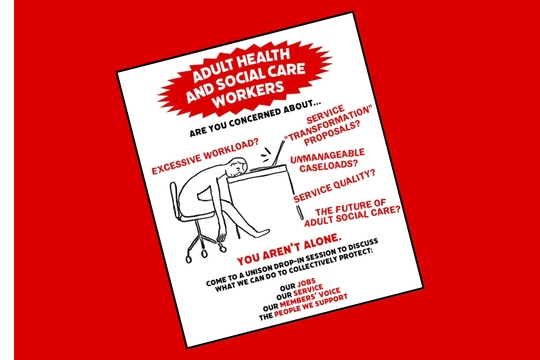
While the group found benefit in venting, we were clear from the outset that this was not the aim of the group. We wanted to use our accumulated knowledge and shared passion to improve the service. For each problem identified, we came up with a possible solution we could put to management, or which could inform worker campaigns. Recognising we would likely be spreading ourselves too thin if we pursued them all concurrently, we identified campaigning to reduce caseload sizes as a worthy first target. The rationale was that if we could reduce our workload, we might afford ourselves breathing room to pursue further campaigns and wins.
We therefore set ourselves two actions to complete before our next meeting. Firstly, we decided one of us would write a letter to management suggesting a reduction in caseload to a maximum of 15 cases. The idea was that we would practice collaboratively editing this letter both prior-to and during the next meeting. Secondly, we agreed to have another meeting, with everyone attempting to bring one more person, with a particular focus on bringing more social care assessors.
Meeting 2
We met again and succeeded in bringing more people in. Some of our members had even felt confident raising the group in their team meetings to generate interest. As some were unable to attend a second meeting outside working hours due to family or personal responsibilities, we discussed how people could contribute outside of meetings by utilising group chats for reflection and sharing actions.
The letter to management about caseloads had been drafted, with a handful of workers adding points and suggesting edits throughout the week. However, opinion was split regarding the final product. Some thought the letter was logical and reasonable, with an emphasis on how reducing caseloads would benefit the quality and efficiency of our work. Others felt it was too demanding and may be taken poorly by management, with suggestions including pivoting to a less risky issue, on which managers may view our input more favourably. It was noted that our different structural positions and vulnerabilities as workers may have influenced split opinion; one locum worker reflected that they may have felt more comfortable signing the letter if they were permanently employed. We wanted to ensure we would open a meaningful dialogue with managers but also show due caution to workers’ vulnerabilities. Therefore, we instead agreed to write a letter to managers simply introducing the group, with a request to meet to discuss how ordinary workers could influence service improvements.
We also returned to discussing financial assessments and client contributions. In the weeks following the first meeting, many of us had experiences which reminded us that people often find their assessed contribution to be extortionate or altogether unpayable. One member involved in UNISON networks across London suggested we use our next session to invite activists from Hammersmith and Fulham who had successfully campaigned to end client contributions for home care, so that we could learn from their successes to form similar campaigns in Richmond and Wandsworth..
Meeting 3
Three activists from Hammersmith and Fulham attended our third meeting, two of whom now worked as ‘co-production officers’, shaping disability policy from a position of lived experience. They showed us a documentary of their campaign and answered our questions about how they successfully ended client contributions for home care. Their campaign was led by people receiving care who believed charging disabled people for necessary care represents a tax on disability, making it inherently discriminatory and harming the autonomy and wellbeing of disabled people. It was also born out of recognition that some local policies harming disabled people are not nationally mandated and can therefore be determined at a local level, as there is no legislation which requires councils to charge people for care and support.
They explained their creative methods to connect to local residents and to fund the campaign, including running pub quizzes and selling t-shirts. They encouraged us to consider political pressure for pursuing our similar goals; their campaign gained momentum in the run-up to local elections through targeted work pushing councillors to put their campaign on the local government agenda. This was not just a matter of finding a sympathetic ear from those in power. Instead, campaigners got councillors in front of disabled residents at public events and surgeries, making them listen to how disabled people are discriminated against by charging (and to show that they, their families and their allies are committed voters!) Through pressure and collaboration, receptive Labour councillors made ending home care charging part of their manifesto and campaigners have successfully held them to their promise ever since. Campaigners became experts in data, evidence and outcomes to more robustly press their demands on councillors, which now includes using research showing hospital admissions and residential care costs have dropped since home care charging ended, to ensure Hammersmith and Fulham do not return to previous charges.
Bringing these activists to our meeting gave us the chance to outline our group and ask how we might replicate their successes. Our guests found our group to be fairly unique within the current disability movement; they were unaware of any other social worker-led disability campaigns across London and were pleased to see an organising effort based on this kind of solidarity. However, we explained that while solidarity is integral to our efforts, we also anticipate our wins to be ‘for us’, in fighting against a culture of burnout caused by exhausting work for so few positive outcomes.
Discussion turned to possible concerns and tensions for our group in trying to affect political change while employed by the council. The main worry was about possible disciplinary action, which may even put our employment at risk. The union organisers present suggested that if we all became union members and ran our campaigns through our branches, this may give us some protection, while also allowing us to affiliate with local disability rights groups to facilitate genuine solidarity and collaboration. Indeed, the Hammersmith and Fulham activists implored us to begin building these connections with disabled residents and involve them in campaigning, to ensure our group has the power, perspective, visibility, knowledge and even the justification to campaign with and for them. We noted that demands to end client contributions may be growing across London, possibly due to the so-called ‘cost of living crisis’, evidenced by similar reductions in client contributions in Tower Hamlets, such that a campaign in this area may be possible at a London-wide or national level, particularly though union networks.
Meeting 4
Reflections on H&F Campaign
In our fourth meeting, we reflected pride that Hammersmith and Fulham highlighted our campaign’s uniqueness for being led by social workers. However, we also recognised it may be difficult – practically and legally – to attempt political campaigning with the communities we are trying to support during our workday, with few similar campaigns to model ourselves on. We discussed that it may be safer to use existing union branches to legitimise and resource our campaign. It remains a point of discussion about how we will have power to continue shaping the group’s ethos if we attempt to associate closely with unions. We noted a recent campaign in Newham libraries where a union rep was targeted and faced disciplinary action for doing anti-cuts campaigning but could rely on wider union support to fight back. If we hope to do similarly political and impactful work, we consider that union protection may similarly be vital. Examples of union campaigning to better resource public services from other London boroughs, as well as recent efforts in Tower Hamlets to end client contributions, have encouraged us to consider how we may stimulate more London-wide campaigning to build greater power.
Group Structure and Workstreams
There was some sober discussion around our capacity within our individual schedules and lives, both inside and outside of work, to pursue the ambitious goals we have formulated. The issue of workloads reared its head again, as we realistically felt we did not have enough time among our caseload to do the kind of analysis, worker-to-worker organising and creative campaigning that our goals required. We did consider working groups, but felt this would likely dilute our collective power. Instead, we felt it was crucial that we secure protected time in our working day to continue our campaigns.
That decision has brought us to our current phase of organising: we have sent a collective letter to management requesting regular time to meet and continue our group. Management have agreed to meet with us to discuss further how the group can have an impact and have suggested they may allow us 1.5 hours monthly to hold our meetings. We have been clear with managers that we intend for the group to be more than a space to reflect and that our ideas must be able to impact service delivery. Managers have suggested that they are somewhat open to receiving such feedback. However, in the context of impending cuts, we know it will be a challenge to promote changes focused upon improving lives rather than simply saving money. That being said, as we have identified ways in which public money is currently wasted by private care companies, we do believe there are even cost-effective measures for improving the service.
How we both utilise union resources and whether we can grow the influence of the union through this campaign remains an unanswered question. We have discussed that we will likely need to learn our way by attempting this kind of worker-to-worker campaigning, many of us for the first time. Generally, we have been excited about the challenge, as many of us feel there is not much hope for doing proactive, life-improving social work unless workers have more autonomy and influence. The belief is growing among us that we social workers and social care assessors will have to work together to make that change happen, rather than simply waiting for it. So that is what we will continue to do.
Do you work in social care and would like to share your experiences with other workers’ trying to get organised? Are you part of an on-going social worker campaign? We would love to make contact and build links, contact us through Notes From Below at [email protected]
-
The Department of Health and Social Care has since seen fit to cancel funding for this program, having deemed each of us too expensive to train: https://www.communitycare.co.uk/content/news/fast-track-social-work-scheme-to-end-in-2027-after-government-decides-to-withdraw-funding ↩
-
Social workers and social care officers both help adults who require support, but the latter group do not require the same level of qualifications as social workers, nor is there the same level of professional regulation and in-theory they are meant to handle less challenging casework which excludes safeguarding. As a result, they tend to receive lower wages. ↩
-
There has been pushback in recent years against using the term ‘service user’, including within our own service. It is only used minimally here, not to define individuals themselves, but rather to reveal a structure of social relationships within which people are rendered disabled and therefore dependent on services delivered by the state in order to live. We find that this usage is consistent with the anti-oppressive theoretical framework of the Social Model of Disability. ↩
-
See:
www.socialworkengland.org.uk/d8ae4f7b295643469c6130e3bcf0325c
www.basw.co.uk/about-basw/campaigning-and-influencing/improving-working-conditions-social-workers ↩
Featured in The Work Ahead (#28)
author
Harry
Subscribe to Notes from Below
Subscribe now to Notes from Below, and get our print issues sent to your front door three times a year. For every subscriber, we’re also able to print a load of free copies to hand out in workplaces, neighbourhoods, prisons and picket lines. Can you subscribe now and support us in spreading Marxist ideas in the workplace?
Read next

The Work Ahead
by
Notes from Below
/
Nov. 17, 2026